
Description
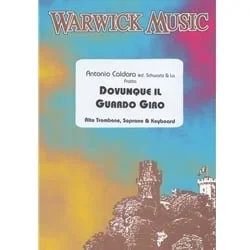
During the Baroque period Vienna was unique in its usage of the trombone in sacred dramatic music. Frequently used in Viennese liturgical music, the trombone found a natural place in oratorios of the period. Stylistically influenced by the Italians, such works consisted of the conventional alternation of aria and recitative. Many Viennese composers wrote such works, Antonio Draghi (1635-1700), Marc’ Antonio Ziani (c.1653-1715), Joseph Fux (1660-1741), Antonio Caldara (c.1670-1736), and Francesco Conti (1681-1732) being some of those names.Antonio Caldara was first employed in Vienna in 1716 and wrote forty-three oratorios during his employment there. Of these, eleven contained trombone parts in their arias. Perhaps the most prolific writer for the trombone in Viennese oratorios, Caldara wrote parts for either tenor or alto trombone. Trombone parts in each oratorio, sometimes as a pair of instruments, accompany other performers such as soprano; two sopranos; two sopranos and tenor; alto; tenor; chalumeau; or bassoon. This aria, “Dovunque il Guardo Giro” from La Passione di Gesù Christo Signor Nostro by Antonio Caldara, utilizes a combination of performers – keyboard, alto trombone, and soprano – that is perhaps an accessible combination for a variety of venues, including chamber music performances and church services. Written in 1730 Caldara’s music was set to a text by Metastasio for a Lenten imperial chapel performance. The music was to be performed during a display of the Holy Sepulchre of Jesus in the chapel.Three excellent resources for study of this music are Stewart Carter, “Trombone Obbligatos in Viennese Oratorios of the Baroque” (New York: Historic Brass Society Journal, 1990, pp. 52-77); Joyce L. Johnson and Howard E. Smither, eds., La decollazione di San Giovanni Battista [by] Antonio Maria Bononcini [and] La Passione di Gesù Christo Signor Nostro [by] Antonio Caldara, introductions by Howard E. Smither (New York: Garland Publishing, 1986); and Ursula Kirkendale, Antonio Caldara: Sein Leben und seine venezianish-römischen Oratorien (Wiener Musikwissenschaftliche Beiträge, Graz: Herman Böhlaus Nachf., vol.6, 1966).Includes Piano score, solo Soprano voice part, and Alto Trombone part.
Reviews
There are no reviews yet.